
HipBiomechanicsApp
iOS Universel / Medecine
Human hip is a biologic system that obeys purely mechanical laws. The main concern of the orthopedic surgeon especially those treating the dysplatic hip is to improve the biomechanical status of the joint. To accomplish this, the surgeon must be familiar with the biomechanics of the hip. Because of the complexity of biomechanical analysis (trigonometric functions, etc.) is almost impossible to calculate in everyday settings, forces acting on the hip, the directions in which they act, and the associated stresses that develop within the joint. With measurements by the App and having numerical data it is possible to evaluate the efficacy or even predict it of the various procedures not on the basis of experience any more.
The Hip Biomechanics App is medical software aimed for orthopaedic surgeons, providing tools that allow doctors to:
-Securely import medical images directly from the camera or stored photos.
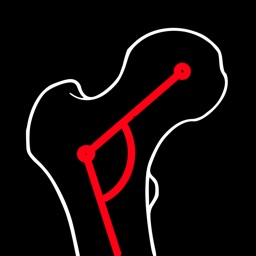
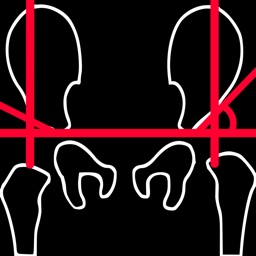
-By marking certain points in a simple standard AP pelvic radiograph, geometric parameters are being calculated. The App computes weight-bearing contact surface, the load (R) and stress (P) on the measured hip.
Data from load and pressure distribution in the hip - like in a real biomechanicals tests- are being measured and depicted graphically as vectors over the X-ray in the screen over the joint. The distribution also of compressive stresses over the acetabulum, which is usually associated radiographic sclerosis over the acetabular margin, are printed in real time over the screen and thus can be easily and objectively evaluated. Besides that, the App provides data in export for diagrams of load (R) pressure (P), which each can be plotted as a curve allowing easy comparison with normal data and thus help decide the orthopaedic surgeon which procedure is objectively indicated.
-The data are printed over to screen so each case can easily assessed
-Save the planned images, for later review or consultation. Data are exported as txt file, ready to print or to input as cells to numbers or excel ready for chart printing and further research.
All information received from the software output must be clinically reviewed regarding its plausibility before patient treatment! Hip Biomechanics App indicated for assisting healthcare professionals. Clinical judgment and experience are required to properly use the software.The software is not for primary image interpretation.
Reference
1. Legal H (1977) Biomechanische Analyse des Hiiftgelenks. Ein Beitrag mit besonderer Berucksichtigung der Druckberechnung und der klinischen Anwendung. Habilitationsschrift, Universitat Erlangen Nurnberg.
2. Pauwels F (1935) Der Schenkelhalsbruch, ein mechanisches Problem. Grundlagen des Heilungsvorganges, Prognose und kausale Therapie. Z Orthop Chir 63 (Beilageheft).
3. Tönnis, Dietrich (1987) Dysplasia and Dislocation of the Hip in Children and Adults. Chapter 4, Current Knowledge on the Biomechanics of the Hip, page 26-57. Book
Disclaimer.
Regarding its plausibility app offers no diagnosis or treatment. App provide an early indication that further evaluation may be warranted by Speciality Doctor. Explicitly is announced that the apps are not for diagnosis. Clinical judgment and experience are required to properly use the software. App alone do not replace an M.D. or specialist. All information received from the App output must be reviewed before any attempted treatment. The software is not for primary image interpretation. Any influence to the operators in making decisions remains user own responsibility and experience. App does not dispense medical advice. Patient should seek a doctor’s advice in addition using the app and /or before making any medical decisions for themself. Never substitute or replace doctors advice or change treatment modalities based on any measured outcome. App indicated for assisting healthcare professionals for scientific and research reason.
Quoi de neuf dans la dernière version ?
Version 8.0 improves reliability and guidance throughout the Hip Biomechanics workflow. It adds expanded anatomical instructions, restores the original calculation and drawing behavior, improves point registration, introduces automatic session recovery, and includes detailed scrollable Help for measurements, load, pressure, graphs, and exports. Consent is now requested at every fresh launchHip Biomechanics 8.0 delivers a more reliable and clearly guided measurement workflow while preserving the original biomechanical method.
This release includes:
• Expanded anatomical guidance for all measurement points, including clearer instructions for A9, V10, D11, and T12.
• Stable point registration using the concentric selector and the dedicated Point button.
• Restored original calculation order, equations, rounding behavior, and bilateral analysis based on the validated v6 workflow.
• Restored acetabular arcs, contact arcs, resultant-load arrows, and the complete pressure-distribution visualization.
• Automatic local recovery of the loaded image, registered points, patient values, selector position, zoom, pan, and interface state after the app closes.
• Expanded, scrollable Help explaining the complete workflow, anatomical landmarks, calculated measurements, graphs, exports, joint load, contact area, and relative pressure.
• Clearer explanations of the difference between hip-joint load and calculated contact pressure.
• Improved image loading, orientation handling, zooming, panning, and image locking.
• Updated privacy, consent, professional-use, and support information.
• Consent is now presented at every fresh application launch.
• Continued support for iPhone, iPad, and Apple Vision Pro.
• Interface refinements and reliability improvements without changing the original Hip Biomechanics identity or measurement sequence.