xsec
macOS / Utilitaires
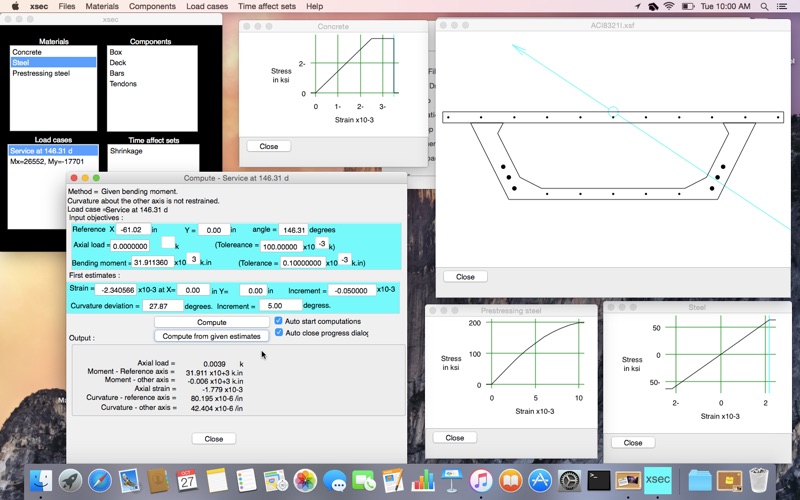
Concrete structural members are designed and analyzed by this application. Specifically, it does cross-section analysis.
It uses an innovative cross-section analysis algorithm that is very universal. The enterprising design professional can take full advantage of their knowledge of the materials:
•to design innovative concrete members,
•to assess the remaining strength in irregular shaped surviving parts of deteriorated or damaged members.
There are no curbs on the input to ensure it is within the realm of established technology. That full universal nature is available.
The established design methods use a variety of shapes for the stress-strain relationship of concrete: the rectangular stress block, the parabolic stress block, linear, cracked linear are examples. Also there are established methods for a variety of cross-section shapes: rectangular, circular and Tee are examples.
This application will accept any shape for the stress-strain relationships, any shape of the cross-section and any arrangement of reinforcing steel.
Also with most of the established methods the results from the application will agree with the results from the established method when the input is the same. Many of the worked examples illustrate this point.
The algorithm is described by Thompson, P. J., Discussion of "Ultimate Strength Domain of Reinforced Concrete Sections under Biaxial Bending and Axial Load", ACI Structural Journal, Nov-Dec 2013, pp 1109-1112.
A warning:
The user of this application needs to be aware of the limitations of the established design methods and aware that this application does not have those limitations.
Quoi de neuf dans la dernière version ?
The output text files and the trial number system have been improved.
The purpose of the trial numbers is to positively identify the cross-section description that corresponds to a given computation result.
A trial number is displayed on all text files describing a load case result.
Also, while there is no change to the cross-section description that trial number is also displayed on all the various text files that describe the cross-section.
The trial number is incremented at the first successful load case computation after a change to the cross-section. That result and subsequent results will all have that new trial number until there is a further change to the cross-section.